Part One of a Series on Street Tactics & Protest Preparedness
Last Updated

INTRODUCTION
We live in a such a complex world that is both dangerous and beautiful, both punishing and rewarding, and everything in between. It is sometimes easy to forget or to not even notice that for the vast majority of species on the planet the primary objective is to survive, and this includes humans. However, humans also fucked that up with power, politics, and the concept of living well and comfortably. This has led to environmental destruction and anthropomorphic (human-caused) climate change ushering the mass extinction of enumerable species. To a large extent and for most of our memorable history, but all the more so in the last few hundred years, most conflicts and aggression are motivated by so much more than mere survival. The aggressors pursue dominance through conquest because living comfortably requires an excess surplus–colonialism and imperialism are prime examples. It is strange, but it is at this junction when both innovation and genocide, opposite ends of the human potential fully emerge. However, regardless of how far down the genocidal spectrum the aggressors go, resistance to their repression and oppression has also always existed and flourished. Still, resistance to repression has always been dangerous because those who tend to have the motivation to do so tend to also be the most oppressed and the least-well positioned within society–political, economic, or otherwise coercive. This chasm has only grown larger with technological advancements such as weapons and surveillance, and the consolidation and encapsulation of resources.
The purpose of this article is to dive into a few elements of resistance, namely, mass movement and quasi rebellion. If you have found this page looking for a revolution cookbook, this is not it, but it will also not be a waste of your time to read and familiarize yourself with the materials contained within because the machinations of the hegemony will also apply regardless of how you choose to resist. This article is likewise not focused on Mutual Aid and doing for ourselves what the government has no business trying to do, and thus, reclaiming our power by building from within. Similar to those who found this page looking for revolution, I believe the contents below will also be of use to you because the hegemony seeks to thwart or destroy those efforts with the same tools and practices. Ironically, our reclaiming power, or in other words, making them obsolete is perhaps the biggest threat to their hegemony that there is. The Black Panther Party for Self-Defense was not considered public enemy number one because they had guns, but rather, because of the breakfast programs, the school programs, the health clinics, and so on that they created. The subject matter and the material contained within this article is pertinent to most forms of resistance that might happen from within the belly of the best of the united snakes.
After more than a decade doing resistance organizing, which includes mentoring and educating others, I have come to the conclusion that some of the most important elements of resistance work and the tactics they use to tear us apart are disregarded or outright ignored. I could not in good conscience dive right in to the hegemony’s assault weapons without first addressing their psychological weapons. Not only is the integrity of our resistance vitally important, but so too, is our ability to sustain it until we win. Remember, this is about survival in the face of a collapsing empire that is pulling out all the stops to maintain its dominance: its monopoly on violence, its license to kill, its license to imprison, its license to surveil everything, its license to bankrupt, and so on. For the hegemonic empire to remain we must be controlled and contained, and for that it seeks to quell any resistance prior to its emergence and when that is not possible, to smash it from within or with external pressure if it must. It would prefer not to make martyrs and to make it appear that the resistance was actually not working in the interest of the people but against the people.
So the first section of this series on Street Tactics & Protest Preparedness deals with the psychological and philosophical elements of resistance, as well as deep dive into gauging whether a particular action or campaign is right for you and why. Resistance can be very dangerous when we are not prepared. Understanding the risks will help you to prepare for them and to hopefully mitigate and overcome them. I go into all this before addressing the elements of the streets because if we wait until the streets to address these things or to be concerned about them, then it is often too late because the destructive force is on a positive feedback loop already. When we are in active resistance, we want our ranks to be as cohesive and as prepared as possible before we engage our opposition. We are counting on those beside and around us to help ensure we not only survive, but that we live to experience our victory.
An essential subject and practice that I believe is a precursor to going out yourself or mobilizing others to do so is security culture. The subject is so comprehensive that it required its own article. I recommend checking out this guide I wrote as part of your preparations.
If you are in the resistance it is important to not only be in out and about, it is also important that you make it home to fight another day and you are not volunteering all of your secrets to be used against you and those you care about. This is as true while you are On the Ground, as when you are in planning conversations, as when you are meeting grandma at a coffee shop for family time.
Who is Responsible for Your Liberation?
This may seem like a silly question, but it has been my experience that may people are often unwilling or are incapable of conceiving of themselves as responsible for their own freedom. It has often been the case that many people are comfortable with other people doing the organizing, the planning, the relationship building and maintenance, and the fighting for them. An important and meaningful the quote from Frederick Douglass that has often been used as a motivator and a benchmark, perhaps even a description of why a society or a people suffer so much injustice is “power concedes nothing without a demand.” This quote seems relevant in nearly every time period since: Jim Crow, Anti-Lynching, Anti-War, Gay Rights, WTO, OCCUPY, Black Lives Matter, Anti-ICE, anon.

https://frederickdouglasspapersproject.com/s/digitaledition/item/10509
However, I have also found that the quote (misused in my opinion) is almost never accompanied with what he said about what the demand entails, how it is made, or who makes it. The element that most people pay attention to is the emphasis of making a demand. However, as I have reflected on this over my time as an activist I have come to the conclusion that a demand without leverage is tantamount to begging.
The question to answer then is how does one, or how do a people gain leverage enough for a demand to have any weight. The answer is that there are many ways. Money is an incredible leverage mechanism and it is perhaps one of the most pervasive in the united snakes. The mechanism may either function as a promise to fund some venture or as a threat to remove the funding from some venture. The latter is something that unions have found to be a superbly effective leverage mechanism for them. While they are not the funders themselves, their actions, like a strike or a narrative shift campaign can have quite the same effect. I have witnessed firsthand how the Left, as distinct of unions for this explanation, has often been wholly ineffective at this approach; save for a few examples like the Montgomery Bus Boycott of 1955. Voting is another mechanism, but very often we are voting on a prepared agenda or a false dilemma over handpicked candidates in this farse of a two-party system. Of course, there is the mechanism of revolt or armed rebellion and sometimes there may be no other recourse for a people to pursue. The uncomfortable reality of the idealistic ‘revolution’ is that what most often happens is that the oppressed become the oppressors, or more often than that, a power vacuum is created and instead of it being filled by those who are the most just, the vacuum is filled by those who are the most forceful. The mechanism that the Left most often employs is critical mass, that is, overwhelming numbers of dissenters. This mechanism is somewhat related with voting in that voting is also related to mobilizing large numbers of people to act. What I am referring to however, are non-violent protests. There is a belief that a sustained resistance of non-violent protests by a small percentage of a society will muster the leverage to overcome an oppressive situation.
Non-violent protests certainly have their place and people utilizing the tactic as part of a strategy have certainly made gains around the world. Nonetheless, there are several concerning factors about the narrative we are fed about non-violence, and how and when to protest, and for what reasons and with whom. We have also been force-fed a revisionist history about our predecessors in the mid-20th century, in particular among other time periods. From all this there is also this entire narrative about the good-protestor, bad-protestor dichotomy. I have written extensively about these things and you can find many of those essays and articles in Lessons from History, so I will not belabor the points here. I will however note that it is highly suspect that our oppressors, who also claim a monopoly on violence, have determined that our only permissible avenue to achieve or exercise leverage is through non-violent means, and even those means are revoked at will.
What does it mean when the people who direct the police see so little threat to their hegemony that they do not even order the police to stop a protest?
Its means the demand is void of leverage.

Now, I do not believe that Frederick Douglass was speaking about this watered-down version of a demand, no, he was talking about rebellion and revolution. He was arguing that our freedom, our liberation from oppression should be as valuable to us our very lives. The speech in which Douglass’s words were pulled from was the “West India Emancipation” speech given in 1857. Just prior to saying that “power concedes nothing without a demand,” Douglass went to some length to stress the personal responsibility we each have for our own freedom. Douglass went so far as to stress that a
person who is not willing to “fight,” that is, take responsibility for their own liberation, “is not, worth being fought for by others.” To put this into context and to get real, Douglass was no Harriet Tubman, who was leading on the Underground Railroad helping enslaved people to escape their captors and shooting them dead if they interfered. Douglass, nonetheless, had his own kind of battles, being a Black man contending in the racist, white amerikkkan political apparatus. The two very different forms of struggle cannot be equated, but it is also impossible to gauge whether or not the 13th Amendment to the US Constitution, the supposed end of chattel enslavement, would have ever come to pass had Douglass not have fought the battles he did. This points to multiple kinds of resistance and a diversity of tactics being necessary for victory. Nonetheless, there is still very much an onus upon each and every one of us to fight for and win our own liberation.
One of my favorite quotes on this matter is from a shero of mine, Assata Shakur of the Black Panther Party for Self-Defense:
“It is our duty to fight for our freedom.
It is our duty to win.
We must love each other and support each other.
We have nothing to lose but our chains.”

If you are part of the collective who feels the call of responsibility for your own liberation and freedom and you are willing to fight for it, then what remains is to dive into how, with who, for what reasons, how to approach the conflicts that will inevitably occur, and how to read situations to your benefit. It is not hyperbolic to state that these things may save your life, but at the very least it may help you to avoid some pain and heartache.
Risk Assessment: Green Yellow Red
Not every fight is one for Liberation. Not every strategy, tactic, campaign, or protest is uniquely situated to focus on your Liberation. This does not mean they are not important, but it does mean that each of us needs to make decisions about how and why we are going to show up.
Building on the framework of Intersectionality, each of us has a matrix of different identities and as such, depending on the circumstances, we or the people around us may have different vulnerabilities we need to account for. Attributed to Kimberly Crenshaw who coined the term in 1989 and the Combahee River Collective for defining the concept in the statement they wrote in 1977, Intersectionality explains how different oppressions interlock and overlap, not only increasing the amount of oppression(s) any one person may experience, but also that at different times a person may experience different forms of oppression depending on the circumstances.
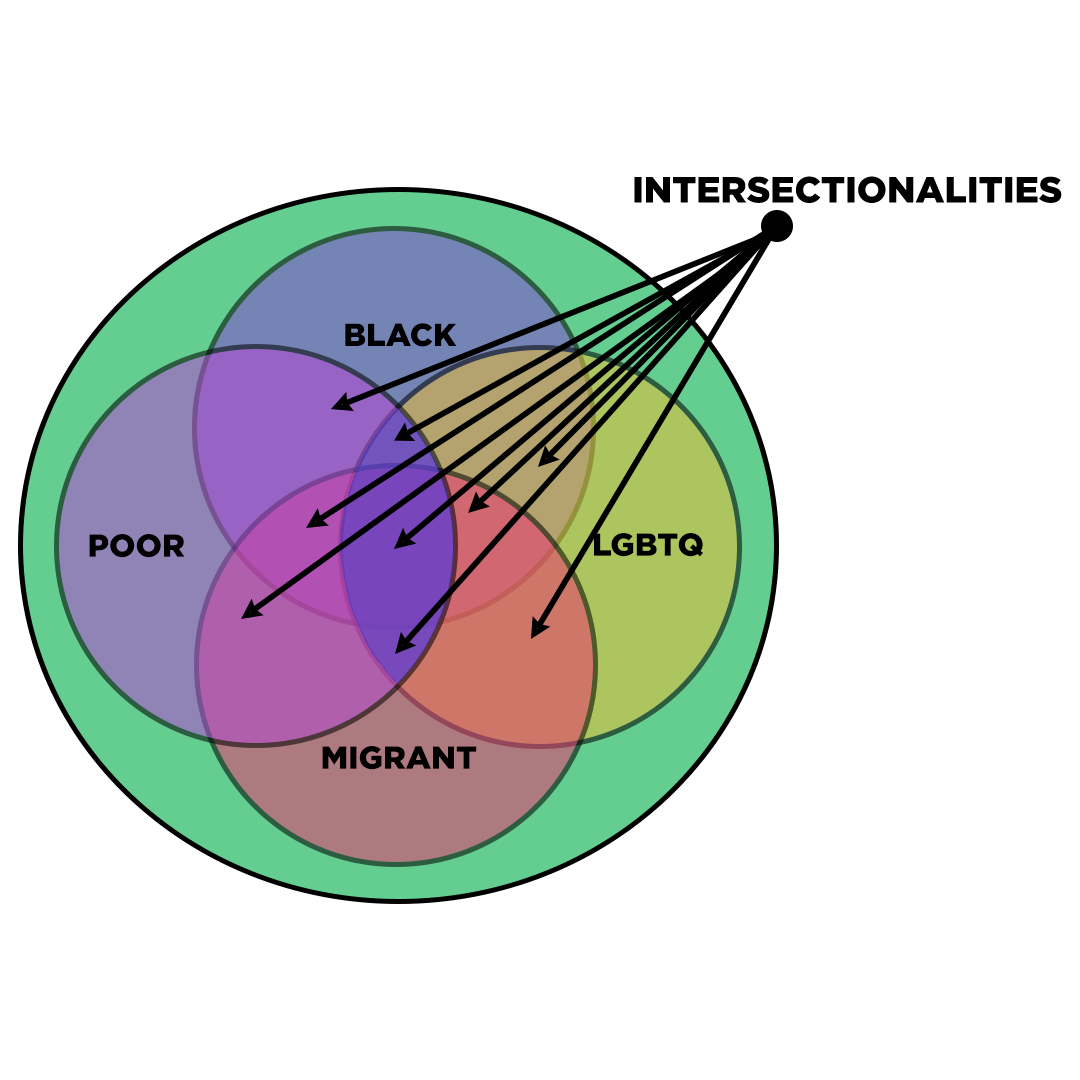
Some elements of our identities are visible or otherwise apparent to the people of the world, like being Black, being perceived as a woman, or our physical ability. While other elements of our identities are not or are much less apparent to the world, like being formerly incarcerated, being an immigrant, our level of education, or our mental health. Yet, regardless of how perceptible the elements of our identity are, two or more of them, perhaps even all of them at once can either become the focus of attention or a limiting factor. Most of us tend to experience different forms of oppression related to the different elements of our identity continuously, although not all from the same source. This stacking of oppressions like the barriers in amerikkka related to being black, and the barriers to being poor, and the barriers to being LGBTQ, and the barriers migrants and immigrants experience, is not only an increase in the intensity of the pressure a particular person experiences, but their vulnerability to threats, harms, and additional consequences also increase.

The Green-Yellow-Red Matrix is a tool that organizers and activists will often use to take what we comprehend about people’s (or our own) intersectional risks and apply a scale. The matrix itself is not foolproof and there is also no guarantee that either what is perceived as, or a person who is perceived as being “low risk” will remain so. Nonetheless, this has been a useful starting point for many of us.
It is very important to note that this is not a tool designed to discourage or prevent people from participation in their own liberation. It is designed expressly to gauge, interpret, and understand the vulnerabilities and threats that a particular course of action may present so that organizers, activists, and resisters can make plans to mitigate those threats, but also most importantly, to organize and mobilize in an equitable manner employing INFORMED CONSENT.
As alluded to above, the matrix can be used with two intentions, the first, as we have been discussing, is about a person’s personal risk in a particular situation. The second, is analyzing a situation itself and defining zones of risk. An example of the latter is that perhaps we might consider people on the freeway, blocking freeway traffic to make a point a “high risk” or red role or red zone of action. Whereas, in the same situation, a photographer taking pictures of the people on the freeway from the overpass above and standing in the public right-of-way (on the sidewalk) is a “low risk” or green role, or a green zone. Using the matrix in this way is about analyzing the threat level of being in a particular place or doing a particular set of behaviors. The benefit to doing a situational risk matrix is that the organizers are not explicitly or exclusively on the hook for doing an analysis for everyone who participates, but is counting on people doing their own personal risk analysis and so when organizers provide people with an analysis of the zones people are better prepared to self-select where they want to be and what they want to be doing.
When conducting a personal risk assessment, it is wise to take into account both forms of how the matrix can be used. The reason for this, is that although a person’s identity will not change and as such, neither will their vulnerabilities, in hypothetical situation (A) where there may be no active threat and thus, while not irrelevant, is not pertinent. However, in hypothetical situation (B) where there is an active threat associated with a particular identity or status, and as such, is quintessentially relevant and pertinent. For example, I am a person of color, of African descent, I identify as male and I am perceived as such, I was for many years a Black Lives Matter activist, and I have been held in a prison. Not that this has tended to stop me from participating in whatever I participate in, the fact is still relevant that me being on the freeway blocking traffic carries with it additional consequences that others may not experience, say, someone who does not have a criminal record. Additionally, a Black male challenging mostly white cops for killing another Black male confrontationally carries with it the risk of being shot dead that is specific to my identity. True, a person having been branded with a criminal record has increased vulnerability in any interaction with the pigs, but not so much visiting the library, or at a Union picket, or holding protest signs and chanting (birddogging) a politician at a speech they are giving on immigration reform.
The context and the situation matters.
Running the Risk Matrix
There are several things that need to be considered when running the risk assessment. You will want to consider your own personal identity and intersectionality. You will also want to consider what the risks are of being involved and what risks you are willing to take.
Personal Considerations:
- Is the action a permitted or an unpermitted event (sometimes it doesn’t matter either way) or do you not know?
- Who is putting on the action? Were you part of the planning or are there lots of unknowns to you?
- What is the focus of the action?
- There are usually big differences in the response to the action depending on whether it is a “white environmentalist” action (which is being considered differently here than Climate Justice work), or an action led by the Democratic Party or one of its offshoots like Indivisible, or an LGBTQIA+ action, or a Black Lives Matter action, or Pro Palestinian action, or an Anti-ICE or Immigrant Defense action.
- We have often found that when either Black, Indigenous, or other People of Color are the focus and liberation is the subject, that not only is there a more direct challenge to the hegemony of the system and those in power, but so too is there an increased response and thus, greater vulnerability.
- What is your identity and what sorts of intersectionality do you embody?
- Building on the point about the focus of the action listed above, it is important to know and consider if you are part of a historically or currently targeted group. If you are, then you will likely have increased vulnerabilities and risks being at an action.
- Do you expect there to be a heavy police presence?
- Are arrests likely to happen? Are arrests being planned by the organizers or activists?
- If you get arrested, will there be additional consequences?
- If arrested for “blocking a public thoroughfare” that is, walking in the street or blocking traffic, which is a misdemeanor at worst and in many states may be equated or reduced to a traffic ticket, but if arrested for that will a previous record cause complications?
- Do you have dependents such as children, elders, or pets who are counting on you to be present?
- Will your citizenship status interfere with your release or could you possibly be subjected to being transferred to an internment camp and possibly deported?
- Are you Trans and will or could the misgendering of you and your placement in the jail lead to additional physical harm and other psychological trauma?
- Is it likely that there will be agitators, provocateurs, or attackers / vigilantes?
- Do you have time-based constraints that are changing your risk level for this particular action?
- Do you have an active case for something else that being caught up in this one might complicate?
- Do you have finals at school or some important work deadline?
- Are you supposed to leave the country within the next week or month?
- Do you have any health related circumstances that might become activated while participating in this action?
- If chemical weapons are deployed then people with respiratory and autoimmune disorders may experience heightened risk levels because those weapons are specifically designed to attack the respiratory system.
- Do you have a sprang joint or another recent injury that may prevent you from quickly responding to a dangerous situation?
- etc…
- Are the organizers working with the pigs?
- How are you doing emotionally in general and in particular about this action and the reason for it?
- Are you feeling escalated at this time in a way that may lead you to make irrational decisions or make decisions in a way you normally do not?
- etc…
There are many things that can be considered a risk that should be analyzed. The example list that I provided above should not be considered exhaustive, but rather, explicative. For example, some people may also have career or scholastic constraints they need to consider. Please use this tool how you see fit if it makes sense to you. Regardless or whether you use this tool or another or no tool at all will not alter the fact that vulnerabilities and risks exist or that if you are an organizer of an event or an action that there is likely to be some realm of culpability for consideration of the risks people are being asked to take. Furthermore, I believe it is our responsibility to do our best, given the information available to us for us as organizers to to prepare situational risks analyses because it is not possible to provide informed consent without it.
Informed Consent is to lay out the context and the expectations as clearly and as truthfully as possible when making an ask so that the person receiving the request is as knowledgeable about the risks and implications as possible so, they may make the most informed decision about, if and how, they want to participate in a particular course of action. To achieve informed consent also requires that a person is in a sober state of mind, that they are not being pressure sold–that is, compelled to make a decision on a speed-clock–, and that a manipulative power balance is not at play–as might be the case with a person who is mentally disabled, or who is very young, or who is new to activism or the movement and very impressionable. Informed Consent is an essential praxis to equitable organizing. It ensures that we are not dehumanizing our fellows and treating them as mere objects or tools to accomplish our own goals. Shirking informed consent is practicing rape culture, which is not part of a just movement.
As an organizer, planning an action that I am going to recruit for I have found it to be an essential practice for me to run a situational risk matrix, at least a draft form, prior to bringing other people in. Then with them leads present in the conversation we collectively analyze the potential risks and their opinions are taken into account. The questions that need to be answered at this junction include the questions listed above plus some more situational elements that are listed below.
Organizer Considerations (in addition to the personal considerations):
- What are the goals of the action?
- Who is the target of the action?
- Who is leading the action?
- What are the roles that will be necessary to accomplish this action?
- Will there be de-escalators?
- Will there be medics?
- Will there be a crew helping with basic needs support, like handing out water, electrolytes, and snacks?
- Depending on the action, is there a Direct Action (DA) crew who will be participating in a little something extra?
- What are the risk levels of each of the roles?
- Are there zones with different risk levels?
- If so, where? What makes us think that the zones will be more or less risky?
- Where is the action going to take place?
- What city?
- Is it private property, public property, or government property?
- Is there an element of the action that is taking place in the street or on the freeway / turnpike?
- Each of these elements matter and they come with different constraints and risks that need to be mitigated.
- When is the action taking place?
- There is a difference between a daytime action and a nighttime action. Often, actions that happen in the dark have been more escalated in terms of responses to the action from both law enforcement and agitators.
- Is this an annual event or an event that is planned out months ahead of time, or is it a spontaneous action?
- What kind of attention will an action like this invite and from who?
- Is there a counter-protest expected?
- Will there be some kind of opposition that we should be concerned about?
- What are the potential or likely list of charges that might be raised against someone in a criminal-legal suit?
- What are the less-likely, but possible charges they may try to tag people with?
- What could go wrong in any part of this action and how might that change our risks or shift our read on the zones?
- Will the action be advertised?
- If the action will be advertised, how will it be advertised and how much?
- We are concerned with how much time the state or other agitators may have to prepare and mobilize a response?
Again, this is not an exhaustive list it is meant to serve as an example and there may be other pertinent questions you should be asking for particular situations? Nonetheless, until such an analysis of the action is completed a true informed consent cannot be achieved. There is a caveat to this because there is a world in which there is not enough time to consider all of the variables that may be at play, like say, a rapid response. In that case, there is a different version of informed consent wherein it is clearly understood that the constraints of the action make it unnecessary or impossible to investigate the risks and that there are many unknowns. This does not change that they should be prepared for and this should never be used as an excuse, like, I or we were too busy to do our due-diligence, that is not okay. That aside, the answers to the questions above, both the Personal Considerations and the Organizer Considerations, should provide you with the information you need to categorize the the action as either green, yellow, or red overall. It will also assist you in defining the elements of the action as either green, yellow, or red specifically. These categories are only short-hand expressions and do not preclude discussing the specifics with your / our recruits. However, at this point, the core organizers and the team leads can now equitably begin recruiting to fill in the essential roles for the action because there is an assessment to provide to them so that they can decide for themselves whether or not they are prepared to assume the risks of participating.
In this current political moment I personally do not think that any action or event is “green.” Two big assumptions about a green action that many make are that there will not be arrests or attacks. In other words, it is believed that with little effort on the part of the organizers or of the participants for that matter, that most everyone will return home in the condition they arrived, for the most part. It is also often an excuse not to build into an action all the necessary supports for supposedly higher risk actions. The old rule book, if there ever was one, has been thrown out and the “rules of engagement” from law enforcement and our opposition shift at will. That is, their behavior has become exceedingly difficult to predict. Roles and Zones that we once thought of as being green, often start at yellow, but are more often a yellow-orange. Please be weary of anyone who tells you “this is a green event” as if to say there is no reason to be concerned about anything, because they are not reading the moment correctly.
It is not the case that everyone needs to know every element of every action. While this may seem to contradict the definition of Informed Consent outlined above there may actually be an increased risk when people have information that they do not need. And although this veers eerily close to Parentalism, it is actually an important element of Security Culture. A person a block away from ground zero holding a sign and chanting on the sidewalk, who has not been to any organizing meetings and shares no meaningful relationship connections with any of the organizers is fundamentally and factually removed in proximity and thus, in culpability in both a moral and a legal sense. From a security standpoint, it is not safe for people not party to an action, even if at the same event, to have information about the proposed course of action. It is neither safe for the people doing the action nor is it safe for non-participants. The non-participant could be considered a conspirator, for one. They may also become a leakage of information, which could either implicate someone, or lead the action to being prevented altogether. Furthermore, how would someone not connected with the organizing get the information anyway? What, a post on fedbook or a general email? No, that is not safe at all.
That said, one, it does not absolve our responsibility to prepare for and to attempt to mitigate the threats and risks. Two, and this is a little more complex, but there are agreements, albeit unspoken agreements, about the parameters of an action or event that often exists. If most of the actions that you, your crew, or even that have happened in your town or city have been done in a particular way, say peaceful, quasi-legal, non-violent marches and rallies then there is likely an expectation. Lazy or inexperienced organizers often exploit that expectation either by neglect or by malice. But say, a local non-profit who is a bit confrontational in messaging, but not so much in action has a substantial following on some social media platform decides to call an action or to promote an action it is a fair bet that most of the people who see the advertisement and more to the point, those who choose to participate have baked into their decision making process and risks analyses an expectation based on previous experience. Similarly, because of how well known I am for building in complex and nearly wrap-around safety protocols and teams to my actions so that participants can focus on the goals of the event there may be a false sense of security that forms when they join another event or action and not make an accurate assessment or take the necessary precautions before, during, and after the engagement. These two examples highlight an incredible responsibility of organizers to either redefine the expectations, i.e., the unspoken agreements and thus explicitly state them in their advertisements, or to simply prepare the action in the manner that is expected.
A person’s Personal Considerations of what is green, yellow, or red may often be dependent upon what they have experienced in the past and what they expect at the current action. If that is correct, then a known shift that remains unnamed or a neglected analysis dissolves Informed Consent and characterizes the action as one that is extractive and exploitative instead of liberatory.
So, while it is the case that not everyone needs all of the intimate details of an action or every component of an action, they do need and deserve a certain level of information regarding the event overall, especially, if there has been a change in how to interpret the Green-Yellow-Red Matrix.
Here is an easy shorthand way to remember, in general, the types of questions to to ask yourself prior to heading out to an action when you are preparing your Green-Yellow-Red Matrix and deciding whether or not the action is right for you, is what I call the C.H.A.R.L.I.E. Check
C.H.A.R.L.I.E. Check
C = Could Anything Go Wrong?
H = Health Related Considerations?
A = Arrestability and Agitators?
R = Role(s) and supplies?
L = Location and Time?
I = Identity and Intersectionality?
E = Emotional Wellbeing?
It is the most wise to have this set up before you head out to an action, but at the very least when you get to an action, and hopefully before it all gets started, you should consider the Buddy System or the Affinity Group (AG) system.
Whether it is one person or a group of people whom we share responsibility with for checking in on each other, it is a good idea. For example, it is not really a good idea to be trying to set up Jail Support while at an action or just before it begins with other people on the ground. Not only are the people you might be able to share this information with also in a risky position and liable to also be arrested and as such, unable to fulfil their commitment to you, but you will need to relay a substantial amount of private information in an insecure place, which may also put you at risk. Conversely, sharing things with your buddy group that may have changed since you ran your Green-Yellow-Red Matrix, such as day-of constraints, is important, like: your current arrestability, or your current emotional wellbeing given the context of the day. It is also a great moment to spot-check that you have all the tools and supplies you will need to fulfill the role(s) that you have taken on.
You may want to check with other people and confirm what tools they have in case you have missed something worthwhile and checking if you can borrow or have one (or some if that is the case, like hand-warmers). Typically however, these are also things that you will want to make sure you have done before heading out to an action, anyway. The Loose Ends part is tricky, because while you will want to have taken into account those things before arriving at an action, like securing someone to feed your pet if the action runs long or you get arrested or hospitalized, but this check-in also provides the opportunity for naming when you have a hard stop, like the end of your shift at the action. This is important because part of the task of your Buddy or AG is to watch out for you while On-The-Ground (OTG). There are usually too many people OTG to track everyone and having a small amount of people to scan crowds for is much easier. If someone needs to leave, do they need to identify another Buddy? They should know that and be prepared for it. If you have a hard stop, this will let people know that they are no longer on the hook for making sure you are okay and can refocus their attention after you leave.
One other important consideration is selecting people you know and trust to do this with. That is not always possible if you try or are compelled to form your Buddy or AG at the action OTG. It is recommended, if and when possible, to establish these connections before heading to the action, but to have a huddle at the onset of the action or your crew joining the action to do a final spot check.
Another helpful acronym that people and organizers have used to remember the elements of this is called the PEARLS Protocol.
P.E.A.R.L.S. Protocol
- Physical Consideration
- Emotional Vulnerabilities
- Arrestability
- Roles
- Loose Ends
- Supplies
Where is the Focus? Who is the Focus?
Until it is pointed out many do not realize how easy it is to lose or shift focus from our objectives and what is important. However, once you see it, it cannot be unseen. This is one part Counterinsurgency, one part PsyOps, one part flash-point-influx or the exhale as I like to refer to it, and one part in-fighting. Regardless of the source though, the impact is the same, distraction from our objectives. The question is how do we maintain our focus while not disqualifying or making invisible the very real conflicts and disagreements that are going to emerge. Furthermore, how do we rank our conflicts and concerns so that we can make decisions about which of them are worth our energy and attention, and when.
Perhaps equally as important as what is happening at an action is who it is happening with. Most of our groups and organizations are pretty scrappy and as such we often need to work in coalition to accomplish our objectives. We are counting on these groups to help with the planning, preparation, and execution of an action, as well as, the follow-up. Rallying for the sake of rallying has, in my opinion, been getting us nowhere. Direct Action (DA), whatever its degree, is a tactic not a strategy itself. A strategy is comprised of many tactics and is usually put into praxis as a campaign or some assortment of campaigns. Since we are not a monolith and since we must work together in coalition to accomplish our objectives, and since our objectives require campaigns to achieve them, this means we are going to need to be in ongoing relationships with many groups and organizations and their members. This very likely means we are going to be depending on one another at multiple actions and other projects that are part of the resistance. This means that the quality of our relationships is essential for our safety at actions and the effectiveness of our tactics.
It’s useful to start with an analysis of focal points or targets. The example I have produced is neither exhaustive, nor is it the only list. Each campaign or each tactic may have its own list and it will likely be completely different. I picked some for reference that seem important in this particular political moment of 2025-2026. For reference, Alex Karp and Peter Thiel are the people at the head of the Palantir corporation, and the GEO Group owns and manages detention centers, in case that was not known.
These focal points, at least on the Left, are less contentious when stating that they are clearly not aligned with our values and are actively working against our interests. This is in part why they are targets. They are also targets because they are perceived as Decision Makers and / or responsible parties to many of the harms we are experiencing. As targets and as our opponents there are particular ways we challenge them, their behaviors, and their products and it is very confrontational. These are definitively what we might call “NO FIGHTS” that is, resistance, as opposed to “YES FIGHTS” or building projects.

There is not a concern for their emotional wellbeing or how they feel aside from that they feel bad for what they have done or are doing, if that. The point is to get them to stop regardless of how they feel about it. We are not trying to be in relationship with these people or institutions. In fact, we are defending ourselves against them, their behaviors, and their objectives.
On the opposite side of the spectrum are our allies, collaborators, comrades, friends, and essentially the configuration of our coalition. I am from Seattle, and when I created the following graphic I just let all the names of all the groups and organizations that I could remember having worked with come to mind as I jotted them down. Accounting for groups that I ran out of space to name, there is like a hundred such groups just in the Seattle area alone who share values and goals.
You will notice another large difference between the first graphic and the second graphic, namely, that in the first graphic from the green power fist their is an arrow pointing at the targets, and in the second, there are two red lines both sitting at the ten degree marks on either side of the protractor graphic. Our opponents are very clearly opposed to us, opposites if you will. However, our collaborators and conspirators are often not very much more than ten degrees of difference in praxis or objective. On the bottom of the

graphic in the black section, I are a list of the points of agreement that most of the groups share deep similarities on. The list includes: housing; employment; respect; dignity; health care; clean air; clean water; food; education; to feel heard and seen; to have autonomy and to be able to express choice; to be treated fairly; freedom of movement; to share in decisions that are important to our lives; connection; community; creativity and creative outlets; enjoyment; safety; security; purpose; trust; life; love; rest and rejuvenation; spiritual freedom and practice, and so on. This list comprises many of the things I believe most people would articulate justice is. I dare anyone to ask any of these groups (or groups in your area) point blank if they or their members disagree with any of these points of unity I have enumerated to challenge my assertion shared values. I have both lived and organized in other places and I know many organizers and activists in many more places and there are similar paradigms in those places, too. So, this is not unique to Seattle. It is just where I am at right now and where I have the most immediate knowledge so, I am using it as an example. The realization I had during the creation of these graphics was twofold. First, there is an important reason for the specificity of focus that each group has because their are conditions and circumstances that each of us are working to resolve. Two, damn, it will be a powerful movement when we unite under one banner and collectively pursue objectives together. I think with our collective knowledge, wisdom, skill, and experience we will be unstoppable.
What is fascinating and simultaneously disheartening though is how perhaps ten degrees of difference can motivate us to forget or disqualify that minimal difference, omitting all the shared values, and treating them as if they are our opposition. Cancel Culture may be in full effect in many instances. In most instances, there is some varying degree of the following though: a disregard for emotional wellbeing; a stern insistence to cease or alter behavior; the creation of ultimatum-based relationships; and defending ourselves from threats by aggressors or people (or groups) who are “unsafe” to be in community with for any plethora of reasons. Anyone or any group is liable to become the focus of our attention and to be identified as our hyper-local opposition.
The difficult part of this is not that the tactics and strategies themselves are not necessarily wrong. In fact, we often celebrate those who can isolate our opposition, find and exploit weaknesses, publicize faults and shame them, and propose collective action to neutralize their capabilities. Yet, should we really be employing the same measures with our comrades that we do with our opponents? No, but that is how many, if not most of us, have learned to deal with conflicts.


https://ccnmtl.columbia.edu/projects/mmt/mxp/speeches/mxt32.html
What is ironic is how quickly and seemingly unconsciously all of this tends to happen without a realization that the focus has been shifted from our actual opposition toward our fellows. A troubling characteristic of this phenomena is likely that much of the source of this are elements of divide-and-conquer strategies deployed against us. This is not to presuppose that there are not very real and legitimate conflicts that emerge both within and between groups while organizing or at actions, because they most certainly do. And this is further not an attempt to gaslight anyone who is in, has been through, or will enter into a conflict at anytime. It is however, a word of caution to spot-check and investigate the context surrounding any conflict and analyzing who benefits from their being a conflict and how.
There are a few lines of thought regarding how we get into these kinds of situations. The first is that we tend to have purist sentiments and an expectation of perfect alignment on purpose, intent, and method. Further, that any deviation from this is a cause for concern leading to a lack of cohesion and often towards a dissolution of the coalition and potentially into mediation, if not directly into cancelling. Another line of thought relates to what I call the Exhale of the movement, that is, the ebb and flow. An exhale often follows some flashpoint moment or occurrence, like the police killing someone, or a fascist being elected, the approval of some new fracking facility placing more people of color in the danger zone, a supreme court decision that strips Rights from people, or something to that nature. During the exhale, there tends to be a large influx of people into the streets, protests, legislature, and organizing in general, and efforts that but a few weeks prior seemed to have almost no energy are then overwhelmed with people. When this happens both new groups form and groups that have existed experience a boom in membership. With this also comes a sea of people who have not yet received much, if any, pop-political-education, have spotty political analyses, and have limited conflict resolution skills, but lots and lots of energy and go power.

In the exhale, people are usually galvanizing and mustering around a crisis, a flashpoint issue, to form a resistance, that is, a NO FIGHT, to stop something from occurring or continuing. There tends to be broad sweeping agreement around what should not be done, what should not happen, and what should not continue. However, when it comes time, and there always comes a time when the resistance starts to negotiate what should be done instead, and the questions of values and methods come into focus (or at least they should). It is at this point that most of the conflict in the movement emerges, even if it takes a while for it to bubble to the surface. While there was agreement about what should not be done, there was no agreement about what should be done. A tangible example of this that I have organized through many times as a BLM activist is when people agree that executions by cops should stop, but there is disagreement over abolition or community control of the police. That question has torn apart so many coalitions and underneath it are values of freedom, control, safety, security and so on, and much of those values depend on class, ethnicity (race), gender, and education. It can become a horrendous mess attempting to rapidly re-educate people about the history and context of power in the heart of an exhale moment at a mass meeting when intergenerational conflict and harm often surfaces.
Entities like a Trump, or a presidency, or an multinational corporation like Palantir, or the institution of policing, or the fossil fuel industry, or Homeland Security are all fantastically enormous and multifaceted. They are almost unwieldly and can appear to be too much to defeat or redirect. In other words, even though they may start as the focus, they may feel like they are too big to fight and win. This is not something the LEFT wants to admit.
Suspicion and blame start to percolate as people begin to question why we are not being effective or why we are not winning. This tends to happen in parallel with sentiments about the “correct” methods or approach to making change and the formation of the belief that we cannot work together or find alignment. It is important to note here that most of us come into the movement with this romantic ideal of a pitched battle with a definitive and lasting victory, but that is rarely the case. It took a hundred years for Black People to win the right to vote, and as we have been observing since the 1970s that can be stripped via felony disenfranchisement, or even more recently as gutting the voting rights act, and what is happening right now with Trump’s executive orders attacking voting ballots and the jerrymandering. Most shit doesn’t happen fast and if we do not remain on guard, then it can be stripped from us. Nonetheless, there is still this expectation of an immediate win, but when that doesn’t happen people will inevitably begin to question why and the analysis I just shared often does not come into focus. Thus, negotiations transform into arguments, arguments transform into conflicts, and conflicts transform into dissolution. Drawing on the example above about the abolition versus community control of the police, once the arguments begin, if people even stay that long, re-education is all but impossible. Pride, ego, and money are also culprits in this drama–self-interest leads people and groups to believe they are “right” and they want the credit–but I digress. Instead of recognizing that abolishing the police or prisons, like Homeland Security, are impossible as one-and-done processes, the end becomes the focus, which then shifts the focus to the disagreement characterizing it as an impasse instead of a bridge to be built later, and collectively selecting agreeable short-term goals to work toward while the disagreement is worked through.
All the while, seemingly almost no one is ever aware of the Proximity Effect. In Hip-Hop we called it the Crabs-In-A-Barrel paradigm. In either case, those who are closer to us are much easier to fight, not only because of proximity, but also because an outcome is much more likely. Using the purity argument as a rationalization our so-called comrades become the focus of our attention instead of the actual threats to our freedom.
There is a certain amount of conflict that is going to happen organically, not only is it to be expected, but I also think that is what we want. The only alternative is for individuals and groups to be in some sort of conflict avoidance state, what Reverend Dr. Martin Luther King Jr. called the “negative peace” in the Letter from a Birmingham Jail, which is a fallacy. Nothing stays buried or contained. It will always find a way out into the open. There is also outside influence purposefully creating dissention amongst our ranks. Case in point, SOMEX, the Federal Bureau of Investigation’s (FBI), Social Media Exploitation Program, and programs like Black Identity Extremist (BIE), and COINTELPRO, and so on. Both the FBI and the CIA, the US Central Intelligence Agency, work to interrupt, confuse, slow down, nullify, or otherwise disrupt and ultimately disband organizing efforts. This includes working to prevent people from even joining resistance or organizing groups. Part of this web of social corruption and interference with freedom of expression and participation in the political process are Psychological Operations, or PsyOps as they call it. The purpose of PsyOps is to get the public to accept an alternative version of reality, largely based on lies, but interwoven with the truth. The best way to make a lie believable is to lace it with the truth. This all taken together with of course the violent incursions are part of a superstructure called COUNTER INSURGENCY and it is aimed at the US population by the US Government, which is under the control of corporations.
I hope that it is not hard to understand why being fed false or otherwise intentionally disrupting information is a threat. I am confident that most will agree that infiltrators, informants, and undercover agents are a serious problem. And while it is not a simple task to accurately identify who an agent might be, people are usually cognizant that they should be on the lookout for them. What people are less primed for is the programming and manipulation that happens on the regular via mass media and social media.
For example, take a couple of sets of contemporary rhetoric and terms like “weapons of mass destruction” and “(domestic) terrorists” and “detention centers” and “detainee” and “fugitive.” These are terms that are being repeated by the federal administration and blasted across the airwaves on an almost daily basis. It’s like, they think that if they say it enough times then it will magically become true. They most certainly appear to be attempting to convince the audiences of amerikkkan media that these things are true. However, they do not withstand too much scrutiny upon deeper investigation. Not saying that I agree with the term at all, but at some point the term “terrorist” had some kind of meaning that people generally understood because it was narrowly focused. Yet, the term has been used to describe so many types of behaviors that it no longer has any foundation to it. Furthermore, the most recent iteration of its application is used to refer to people practicing US-American-tradition: exercising their First Amendment Rights to freedom of expression and freedom of association; asserting their Fourth Amendment Rights to privacy, respect and dignity, and against unreasonable searches and invasiveness into their lives and property; asserting their Second Amendment Rights and the spirit of the Declaration of Independence to resist tyranny and despotic governance; Asserting their Fifth and Sixth Amendment Rights to not be killed for a supposed “crime” and especially not without any formal indictment, or a trial with an impartial jury of their peers. To put this into plain terms, this administration has equated terrorism with meaning asserting the Bill of Rights enshrined in the United States Constitution. The term fugitive also does not hold weight because the people they are describing are not people who have “fled” confinement or custody, but many of who are actually in active consensual legal negotiations and have been living and behaving in compliance with all court directives. Then there is the glaring application of the term detention centers when in fact, they are prisons insofar as the actual structures and the companies who own them are concerned, but are actually internment camps and torture chambers by how they are being used. The people being held there are not detainees, but rather, they are prisoners. They are attempting to convince the public of the definitions they have applied to these terms to advance their agenda, to thwart accountability for violations of the law, to avoid the very real responsibilities they actually have to respect the rights of the people they are hunting, beating, maiming, incarcerating, and killing, and are casting the people simply defending ourselves as the enemies. How can a child of seven years of age, being held in an internment camp, be an enemy of the state?
An older example, but connected to the ones enumerated above were the repeated claims made by both the republican and democratic parties from 2001 to the present about “terrorists” and “weapons of mass destruction.” They said it over and over and over and over again, and had absolutely no proof, and in fact, it has been proved that they knowing lied about both Iraq and Afghanistan. What the Bush Administration did post 9/11 at Guantanamo Bay violated the constitution, federal statutes, and international law including the Geneva Convention. The Bush Administration handed down a directive not to refer to their prisoners as “prisoners” because they were torturing them under the term “Enhanced Interrogation Techniques” and they wanted to get away with it. The facility was also not called a “prison” but a base, ironically, and all too reminiscent of what is happening now. This is the same credibility gap that was rampant during the amerikkkan war against Vietnam, with the same front of lies to allay the amerikkkan public. There is nothing new about any of this.
We must be exceedingly careful about what messages, about what “spells” as Don Miguel Ruiz Jr. would call them, we accept into our makeup.
I selected to highlight those iterations above not only because of how poignant they are to the current political moment in which we find ourselves, but also because they are easier to spot, research, and comprehend than what I am preparing to discuss. The mainstream media, SOMEX and social media in general, and infiltrators have been diligently working to play off our fears by spreading a narrative about who is a Good Protester and who is a Bad Protester. According to them, the “good” protester, if there must be a protester at all, is the quiet, the reticent, the non-violent, those who will simply turn the other cheek when beaten or abducted and caged, the ones whom are easily dissuaded, and who also work with the same “authorities” –authoritarians– to get rid of the “bad” protesters. According to them, the “bad” protester is anyone who does not fit the “good” protester paradigm and model. More to the point, those who do not ask permission to protest and get a “permit” from their oppressor to resist their oppression. The “bad” protester is the one who will not immediately leave a space because their oppressor is tired of them being there. The “bad” protester is the person who will not simply turn the other cheek, but will resist repression and defend themselves, if necessary. The “bad” protester are those who interrupt business as usual, interfere with capitalism, and tear down the tools and structures of oppression and repression. These “bad” protesters are vilified and blamed for the horrendous, heinous, and violent abuses from “law enforcement.” They will often argue that the “bad” protester “started it,” which is the same bullshit they try to claim about Gaza and the Palestinian People. They simply omit all of the historical violence that is often generations deep then, they label a self-defensive act as an act of aggression, and the mainstream entity accepts these accounts because they receive them from people who they believe are “authorities” on the matter. Of recent memory, Black Lives Matter was targeted in this way, as were the activist resisting Cop City in Atlanta, as well as those in the Pro-Palestinian movement, and their general catch-all-blanket group names–ANTIFA and Black Block, which both somehow seem to also defy any narrow definition by them.
These are divide-and-conquer tactics plain and simple, and is a quintessential example of COUNTER INSURGENCY, which aims to interrupt, confuse, slow down, nullify, or otherwise disrupt and ultimately disband organizing efforts. Is it a wonder that after so many groups and general methodologies have been torn down for so long in mainstream media and on socials that people in the Exhale after a flashpoint moment are reluctant to associate with them? We have been so effectively painted as the enemy that the members of our own communities do not trust us. What is more insidious is that this complex web of social programming actually starts in children’s video programming and books, and continues in grade school in amerikkka. There are clear distinctions about who is good and who is evil, and who is the hero, and very often it is some form of “law enforcement.” And that is but one form of COPAGANDA that is used to indoctrinate us. A common trope, is that intelligent and powerful women who care for connection to their community and our planet, and desire to interrupt the destruction wrought by the status quo are “evil witches.” Evil is “dark,” evil is “black,” dark and black are scary. Then there are all the historical rewritings about lone (male) heroes who were loved for their non-violence and are the model for how to behave and pursue change now. But this makes invisible the entire complex spectrum of the diversity of tactics and strategies, and the thousands of people who brought about the changes. These are the foundations upon which their PsyOps project connect to. The result is not only a distancing, but but a stigmatizing, ostracizing, and targeting of the “bad” protesters, as they convince new comers to partner with the hegemonic enforcers to stop the “bad” people from ruining democracy.
If critical mass is the form of leverage that we are attempting to exercise, the situation that I have been describing is part of what has almost systematically disintegrated that leverage every time it has had any opportunity to be harnessed over the last 40 years. With but a few choice words by a few well-positioned people and the focus of the resistance is turned in on itself.
Recall the concept from the beginning of this section regarding how our collaborators and conspirators are but maybe only about 10° of difference in objectives and methods? Hold onto that. Add to it the good protester – bad protester dichotomy just discussed. Now we’ll dive a little bit more into the SOMEX because so many of us use and organize on social media. Social Media is really a double-edged sword. It is on the one hand an effective tool for getting information in front of people, for dialogues, sharing current affairs and remaining connected. However, it is also simultaneously and arguably the most effective social programming tool ever created. It is also often one of our greatest vulnerabilities, both as individuals and as groups. One of the primary functions of the engine is a practice known as Data Mining, or Harvesting. People volunteer almost everything about themselves and their lives to the cloud in text, audio, photo, video, and other document formats. Some of this is intentional, but the vast majority of it is not, it is happening without the “user” ever knowing about it. (Check out my article on Security Culture, if you have not already, and you are looking for some steps you can take to protect yourself.) In general, there are psychological tricks and tactics that can be used to push and pull people, or otherwise influence their behaviors without knowing anything personal about them. Add to that a lifetime report on decision making, connection integrity, and emotional motivations and what they have are quite literally the keys to our psyches. The pigs, both the feds and the local police everywhere, not only recognized this treasure trove, but also maneuvered to capitalize on and exploit it, or rather, us. There are not even seeking to conceal this fact as is evident by the name they selected, Social Media Exploitation Program. The primary objectives of the program are to identify targets, investigate targets, infiltrate targets, and disrupt targets. The program is officially housed under the FBI, but the FBI works directly with local law enforcement agencies through what are known as Mutual Aid Agreements. (There they go again, coopting corrupting another term of ours and turning it against us.)
Now, going back to the graphic with the hundred or so closely aligned orgs and nearly all of them are on social media in some capacity, and if not the groups itself, the members of the groups are, but most groups in addition to their members are there. A few timely and well-placed messages with the right people can throw all sorts of wrenches into our organizing efforts and create dissention among our ranks and fledgling coalitions.
These messages do not need to be outright accusations, even though those do happen, both online and in-real-life. All these messages need to do is trigger an emotional response to previous programming to achieve its objective. This might look like a bunch of posts or advertisements about MLK or Gandhi, and nonviolence. Or it could be messaging about how Russia or Palestine are infiltrating groups in the US turning them un-amerikkkan groups–aka, terrorists. It might be a bunch of “positive” messaging about how “policy” is the correct and only means of a just change. (A quick aside: have you ever notice how close in both spelling and action both Police and Policy are? Enforcement and control are the terms of the day.) Or, there could be posts or messages that specifically target a group or group of groups, highlighting and vilifying their methods, objectives, tactics, or strategies. Anyone who has actively used social media for any length of time will undoubtedly have at least asked themself the question, if not spoken it to others, “why I am not seeing (so-in-so’s) status updates?” or “wasn’t I just talking about this?” Artists, companies, and even organizations often refer to this as the Algorithm, a set of code that dictates to us what we should see and when. A computer program, created by humans with marketing and social engineering goals, who work in collaboration with law enforcement and the government, are determining what information we should see, when we should see it, and for how long we should see it. Things do not go “viral” by accident, that is coordinated for a purpose. The cold part is not that everything is a lie or a falsehood, in fact, a good portion of it may be true, or at least a real opinion. In any case, the intent is to foment dissention among our ranks.
“The single story creates stereotypes, and the problem with stereotypes is not that they are untrue, but that they are incomplete.” (13:10)
“So that is how to create a single story. Show a people as one thing, as only one thing, over and over again, and that is what they become.” (9:25)
~Chimamanda Ngozi Adichie
“The Danger of a Single Story” TED Talk
One of the most effective strategies in war is for one to compel their opposition to fight among themselves. The STATE, is a repressive propaganda machine that has been programming society for generations, indoctrinating us with loaded terminology, that they can pluck at a whim, to create an existential crisis within most individuals. They use this form of mental manipulation to create fissures and ruptures from within unifying structures of resistance. In other words, this is COUNTER INSURGENCY in a nutshell and in the context of this section and for Street Tactics in general, it is something that we need to be highly concerned about because we are counting on the people beside and around us for safety, security, and victory both on the streets and in our long-term strategy and campaigns.
We must institute a practice of being highly suspicious of nearly every piece of information that comes to us. We cannot allow ourselves to ingest information passively any longer. That is something they are banking on when they are working to program us. We must train ourselves to actively and inquisitively listen, read, or watch everything that is being transmitted to us via mainstream and social media, or even when it is someone else bringing that shit to us and we are not online. It is true that there is a natural tendency of people to associate and to disassociate with people for a litany of reasons. This freedom of association is healthy and necessary. It is also true, that devious and oppositional entities exploit this natural tendency and twist it to their advantage. So we must have a critical mind and we must use it continuously, but especially when we are acting in resistance to repression and fascism.
The Critical Mind
A simple way to critically analyze whether a report, rumor, or accusation is divisive is to investigate whether its intent is to tear apart the organizing, movement, or action, or whether the intent is to strengthen us.
- Do Not echo, amplify, or create messaging that plays into the Good Protester – Bad Protester dichotomy, thus vilifying our own people and doing the pig’s work for them, tearing ourselves apart from within.
- A message to people who know us or are otherwise from our community is much more believable. It is on us not to become their tool of disintegration.
- Do Not create rifts in the middle of an action by identifying groups who are collaborators and conspirators as “violent agitators”
- There are those who are not our collaborators and conspirators whom we can identify, though, because they are there to create dissention and harm, and this can be determined by their actions in real-time.
- Do Not work with the pigs
- Do Not “tone police” marginalized people or Peoples
- Do Not tell people what they can say or how to say it
- Do be critical of any divisive claims or messaging whether in-person, in-real-life, or online or on tv.
- Do highlight an amplify the messages of the carnage and violence of the STATE sanctioned violence against our Peoples
- Do shield leftist and radical agitators from harm and get of the way when they move forward into defensive or offensive positions both online and IRL.
- Do go to the source when you hear a rumor. If you hear something about someone, go to them and find out the truth.
- Do Not just spread that shit around and let it catch fire.
Some things to watch for and help you to identify PsyOpps; they tend to use logical fallacies in their argumentative structures:
- Appeal to Emotion (fear, anger, hope)
- Strawman Argument (misrepresent argument to attack it)
- Bandwagon Fallacy (good/true because everyone supports it)
- False Dilemma (presents only two extreme options, ignores alternatives)
- Ad Hominem (attack person, not the argument)
- Appeal to Authority (claimed true because an authority figure said it)
- Slippery Slope (one action leads to an extreme outcome)
- Hasty Generalization (broad claims with little evidence)
- Red Herring (distracting people with irrelevant information)
- False Equivalence (compares things as equals when not at all true)
The unfortunate reality is that nothing is ever simple hence, the warning to “be critical” of divisive claims or messaging and not to outright reject them merely because they are divisive. There are some very real harms that may enter into our spaces and corrupt our community and our organizing. A common occurrence is something that Women of Color Speak Out (WOCSO) called MACKTIVISM, that is, the practice of someone who is typically male-identifying, who also has a prominent role in social justice spaces, and who often preys on newer, younger, more naive and more impressionable female-identifying activists, organizers, and volunteers. It is a fusion of two terms, macking, which is slang for seducing, and activism. These men, armed with social justice language, who have a reputation that others respect and look up to leverage their status to emotionally and sexually exploit these women who feel “safe” with them because of their status. This practice is not easy to identify for a few reasons. One, as is common with Rape Culture, those who are harmed are often afraid to say anything in the first place and then are gaslit and silenced when they do. Two, the predator is very often protected because other members of the community, who this person treats with utter respect, is perceived as someone too important to lose, or imagined to be the victim of false targeting. As a result of not interrupting this behavior early on, these men leave a wake of vulnerable people harmed behind them. The catch-22 of the result, is that until there is a result as such, it is hard to identify the pattern and thus, to intercede. When this type of predatory behavior is brought to light about a person it is divisive, but it is not wrong. It is our duty and responsibility to interrupt this type of behavior and our honor to protect or support the integrity of the people who come into our movement with the promised expectation of respect and dignity, regardless of the perceived importance of the perpetrator. It is divisive, but only insofar as the intent is to isolate the source of harm and to strengthen the integrity of our community.
This is a reason to shift our focus, not off of our goals, but definitely toward our community until the festering threat consuming us from within and the healing that needs to occur can happen.
Another complex situation that requires a very critical mind and is also a reason to not reject divisive claims on their face value regards infiltrators, informants, and undercover agents. There will always be risks when engaging in social justice, but this is especially true for Black Liberation, Indigenous Sovereignty, Anti-War, Pro Palestinian, and Anti-Capitalism work. Organizing that advances race based politics, or challenges the status quo of Capitalism or the monopoly of military violence, which are often all equated with anti-nationalistic ideologies are under threat from hate groups and state actors alike. We won’t be able to identify them all, but here are a few examples:
- Law Enforcement Agencies
- Fusion Centers
- White Supremacist Organizations
- Zionists
- Infiltrators
- Informants and Collaborators
- Well-meaning, but ultimately Naive Folks
The most common risks to organizing are the people who are naïve about the risks, the actors, and the information they share freely. The most insidious and potentially dangerous are the infiltrators and informants. Take for example, William O’Neil, in the black and white photo. O’Neil was the FBI Informant who sold out the Chicago Captain of the Black Panther Party for Self-Defense, Fred Hampton and his family, by providing a detailed floorplan of their home and drugging Hampton the night the Feds shot up their house killing him. O’Neil was Hampton’s security detail and lieutenant. He was someone vetted and trusted. He was flipped. We will not always be able to read everyone. We will not know if person A or person B is the one who will share our secrets. Even the best screened and most trusted people have been revealed as informants. It wastes a lot of energy and time pointing fingers without real evidence. That insidious suspicion which always seems to pop up, has turned friend against friend and destroyed organizing, organizations, and the reputations of comrades’ time and again. We call this practice Cop Jacketing or Fed Jacketing.
Conversely, our bodies are telling us something important when our gut starts gnawing at us about a person. They may not be a cop or a fed, aka one of the pigs, but there is something your spidey-sense is telling you is not right. I recommend trusting your gut. This is a difficult situation to be in because this is not one of those when you can simply go to the person and ask, “hey, so I was wondering if you could clear something up for me, are you a FED or are you working for them?” If they are, they are not legally bond to answer that question, and even if they were, the government and its agents break the law all the time. Also, as mentioned above, sharing this with a lot of people is also neither wise nor aligned with our values because it create a rumor mill. So, what should we do in these situations?


There may be no getting around sharing our gut impressions with at least a few people who are also primed about the pitfalls of fed-jacketing, and know to keep the information close to chest (secret). Next, the following proposal will work much better with new or newer recruits than someone we have been organizing with for years, but not impossible. Referring to the diagram with concentric circles labeled movement, community, core, and nucleus this is an example of an onion organizing model, and the other diagram with the groups categorized by color is an example of the snowflake organizing model. These two models can function together and can be used to reflect levels of trust, as well as channels of communication–or access to information. When a person comes into an organizing space they are normally immediately brought into the nucleus for multiple reasons; at the top of which are interests and skill, but also trust. Over time, people develop skills, relationships, and trust and are brought in closer to the center of the organizing.
With these models and practices in mind, the most practical suggestion about managing infiltrators and informants in our spaces and the gut feelings (because there is mostly no way to get “proof”) is to restrict deeper inclusions until the gut feelings can be sorted out. This is why there will likely need to be some discussion with other trusted comrades about the gut feeling because it will likely require a concerted effort to direct the person to the part of the organizing where they can do good and not corrupt at the organizing at the same time. Infiltrators, when they are FEDS tend to exhibit some common traits that we must watch for. The most glaring one is the infiltrator will repeatedly try to talk us into escalations. This will probably feel more like manipulation than motivation, but I admit that the two are easy to get confused. Second, they will also seem to have all the things that we need when we need them, or they know how to access them thus, making themselves seem indispensable. This might be money, or relationships, or tech, or access. We cannot just go online anymore to track how far back a person’s “activist” story goes back because of SOMEX and the maintenance of long-standing profiles, but that does not mean doing some investigations about people is not warranted or fruitful. Be warned that just the asking of questions will cause flags to be raised by others and will start the rumor mill. I tend to allow the relationships to grow normally and to get to know them as I would anyone else. Over time, I have seen if my gut feelings were justified or not and to date, this process has not failed me, yet (to the best of my knowledge). Another thing to watch for that is connected to the manipulation of escalation is the person may seem to have a lot of energy of “get shit done right now.” This one can be a double-edged sword though, especially during a flashpoint moment with a large influx of new people who are energized. Our guts may (as I have often observed) misinterpret new energy as cop energy. This has led to the fed-jacketing of many. Watch for these things while you find a place for them to be in the organization.
A lesson from our predecessors that I have held onto for a long time now is that the cops will always be present, that is, our oppressors will be working to infiltrate and dismantle our organizing and resistance for so long as we are the resistance. Their objectives are achieved whether they incarcerate, kill, or disintegrate our movement. If we implode because of we shift our focus and start finger-pointing and fed-jacketing, then they win. Our predecessors recommended that we know the feds are present and we just keep organizing. Fuck’em!. Thus, I have carried it further by finding a place for them and holding them there until I can resolve the gut feeling. It is possible that the gut feeling is because they are a creeper. Cops are not the only threat and sometimes it just requires a little time to get to the bottom of why our guts get active with some folx.
Before transitioning from the conversation about vetting and infiltration, it is worthwhile to share a little about Operation Puppet Master that went down in Minnesota when Renee Good and Alex Pretti were killed by I.C.E. Agents. Operation Puppet Master was the mass surveillance campaign of the State targeting all of the organizing going on in the city. They recorded, followed, infiltrated, and all the things. As you will have read in my DigiSec article there is a company called Paragon that has encryption breaking software, making things like Signal and WhatsApp vulnerable. However, it was not the spyware that granted these infiltrators the information they were after, it was the groups volunteering the information themselves by allowing the infiltrators into organizing Signal threads. That is promoting a new comer into the nucleus and there are lots of risks associated with that. The feds also pulled financial records and joined mass meetings in public places to identify targets and form relationships. That as has been discussed is to be expected. There is a Catch-22 here, in that it may seem impossible to organize if we cannot add anyone for fear of infiltration. Keep in mind the concentric circles of the Onion and Snowflake models. Think about what information should be shared with which audience and which tasks should go to which groups. Keep this in mind always.
If you are someone new into a space and are growing frustrated with how slowing you are being brought in, please keep in mind the situations discussed above. In many of our relationships it is a common practice to “move at the speed of trust.” This is not always comfortable, but it will happen.
Speaking about Security Culture and a recent practice that has emerged that is making things very difficult regard the unclear and changing names on a consistent basis. Because platforms like Signal allow people to change their names, people do, and the belief is that this makes things more secure. This may seem to be an effective strategy to thwart being tracked and targeted, but all it does is create a culture of not knowing who anyone really is. The only benefit I can see is to the individual themselves and even that is fleeting. In the case of Operation Puppet Master, let’s say that we were applying a praxis of concentric security culture but we could not be sure of anyone’s name on the platform, then what have we really achieved? This is not to suggest that monikers are not valuable. Quite to the contrary in face, they most certainly are valuable and effective. You should totally make one because doxing is a real, traumatic, and harmful thing. But the rote changing of names is risky business. There may be efficacy to strategically doing it for an action or a campaign, or when traveling, but not all the time.
Lastly, we must decide the level and type of group that a group is. Is it an open-door, all inclusive entry point into the movement space, or is it an Affinity Group (AG) with very specific objectives? It could be something in between the two extremes, but regardless of the configuration, each configuration needs to have different vetting procedures and a clear understanding of their vulnerabilities.
Conclusion
There is so much that I wish I knew as I started doing activism and organizing. I have tried to distill some of the most important lessons that I have learned here. The most important and although it may seem obvious, the most difficult part of activism is the relationships. Our relationships can destroy or save us. I bet that most of the people who read this article and especially those who get anything from it will be the people who have been in the movement for a while, not necessarily the people who are thinking about heading to a protest. My hope is that this information will make it to people who are still in their first year or active resistance. I hope you will be able to side-step some of the pitfalls that me and my comrades have fallen into and that you are better prepared to weather the storm than we were / are now. The enemy before us is like none the world has ever seen before and they have so much more information and control than any regime has ever claimed in the past. We are in uncharted territory and that is why I believe this information is so timely and important to share.
When I started drafting this article I was creating an article version of a training slide-deck I created about the weapons and tactics of our opposition and what we can do to overcome them. In that deck there is a focus on the information that is above, but it was cursory compared to what I have written here. This subject matter became so robust that I decided to convert it into a series and connect with the other training materials related to resistance health. I believe that the quality of our relationships is the most important aspect of the work we are doing. So understanding how our relationships might be exploited or the things that might corrupt them from within is essential. Too often, manipulation leads those of us in the movement to shift our focus from our oppressors to our comrades robbing our resistance of energy. At times, it is as important and right to do that internal work for our movement spaces, as it is for us to do the same for ourselves, but that needs to be an active and strategic decision we make.
In sum, I believe that it is within our grasp to achieve a mass movement worldwide that will allow us to usher in the world we deserve. As I shared above, the graphic with all the names of the different organizations on it that it will be wonderful when we are all working on the same objectives together because then we will be unstoppable! For that to happen and in the process of it happening we are going to have to become the people who belong in the world we are creating and the only way for that to happen is for us to evolve our relationships with each other, and that will only happen when we each realize that we are each responsible for doing that work and for our own liberation, understanding that our liberation is tied to each other’s liberation.
Leave a Reply